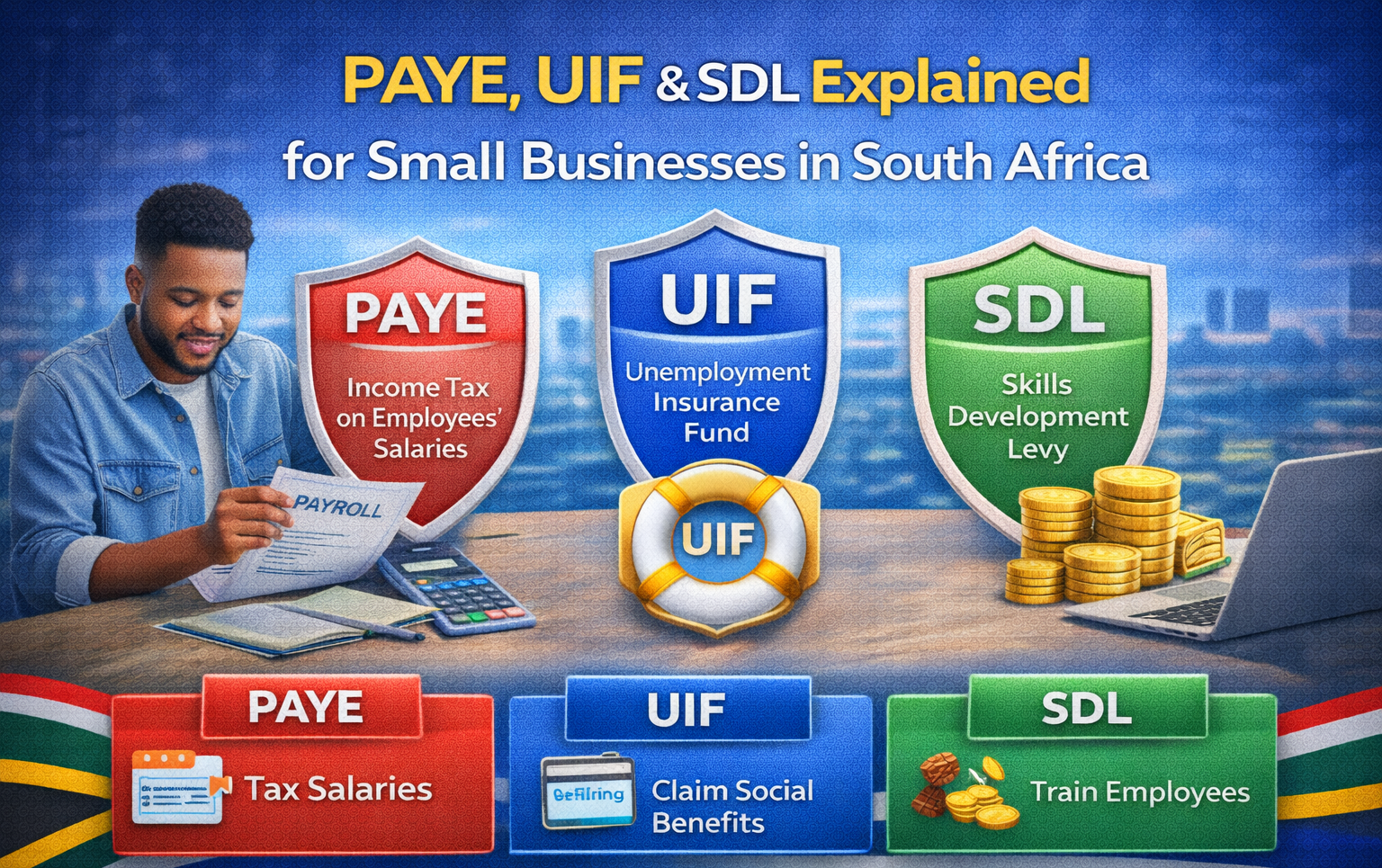
If you employ people — even just one employee — you’ve probably heard these terms:
-
PAYE
-
UIF
-
SDL
But what do they actually mean?
And do small businesses really need to register for them?
Let’s explain it simply, without the jargon.
What Are PAYE, UIF & SDL?
PAYE, UIF, and SDL are employee-related taxes and contributions that employers must handle on behalf of their staff.
They are managed by the
South African Revenue Service (SARS)
If your business pays salaries or wages, these registrations are usually mandatory.
What Is PAYE?
PAYE (Pay As You Earn) is the income tax you deduct from an employee’s salary and pay to SARS.
Key Points:
-
Deducted monthly from employee salaries
-
Paid over to SARS by the employer
-
Based on the employee’s earnings
PAYE is not extra tax — it’s the employee’s income tax, paid monthly instead of yearly.
What Is UIF?
UIF (Unemployment Insurance Fund) provides short-term financial relief to employees if they:
-
Lose their job
-
Go on maternity or parental leave
-
Become ill
-
Pass away (benefit paid to dependants)
How UIF Works:
-
1% deducted from employee salary
-
1% paid by employer
-
Total contribution: 2%
Almost all employees must be registered for UIF.
What Is SDL?
SDL (Skills Development Levy) helps fund training and skills development in South Africa.
Who Pays SDL?
-
Employers with an annual payroll above R500,000
How Much Is SDL?
-
1% of total payroll
-
Paid by the employer only
If your payroll is below R500,000 per year, you do not need to pay SDL.
Who Must Register for PAYE, UIF & SDL?
You must register if:
✔ You employ one or more employees
✔ You pay salaries, wages, or stipends
✔ You are a sole proprietor or Pty Ltd
Business structure does not exempt you.
How to Register for PAYE, UIF & SDL
Registration is done through SARS eFiling.
You will need:
-
Business tax number
-
Company registration documents (if registered with
**Companies and Intellectual Property Commission) -
Banking details
-
Employee information
Once registered:
-
You submit monthly EMP201 declarations
-
You submit annual EMP501 reconciliations
How Often Do You Pay PAYE, UIF & SDL?
Monthly:
✔ PAYE
✔ UIF
✔ SDL (if applicable)
Annually:
✔ EMP501 reconciliation
✔ IRP5 certificates for employees
Common Mistakes Small Businesses Make
❌ Not registering when hiring first employee
❌ Missing monthly submission deadlines
❌ Deducting PAYE but not paying SARS
❌ Forgetting EMP501 reconciliations
❌ Mixing payroll and personal finances
These mistakes can result in penalties and interest.
Do You Need PAYE, UIF & SDL If You Pay Casual Workers?
Yes — in many cases.
If a worker:
-
Is paid regularly
-
Works under your control
-
Is not truly independent
Then they may still be considered an employee.
When unsure, it’s safer to register and declare correctly.
Final Thoughts
PAYE, UIF, and SDL are not optional once you employ staff.
✔ They protect employees
✔ They keep your business compliant
✔ They are required for funding and tenders
Good payroll compliance builds trust and avoids costly penalties.
NextStepZA helps small businesses understand compliance, registration, and funding — step by step.
Business Readiness Checklist
Career Store
Frequently Asked Questions (FAQs)
Yes, if they pay salaries above the tax threshold.
Yes, for most employees.
Only if annual payroll exceeds R500,000.
Yes. Sole proprietors with employees must register.