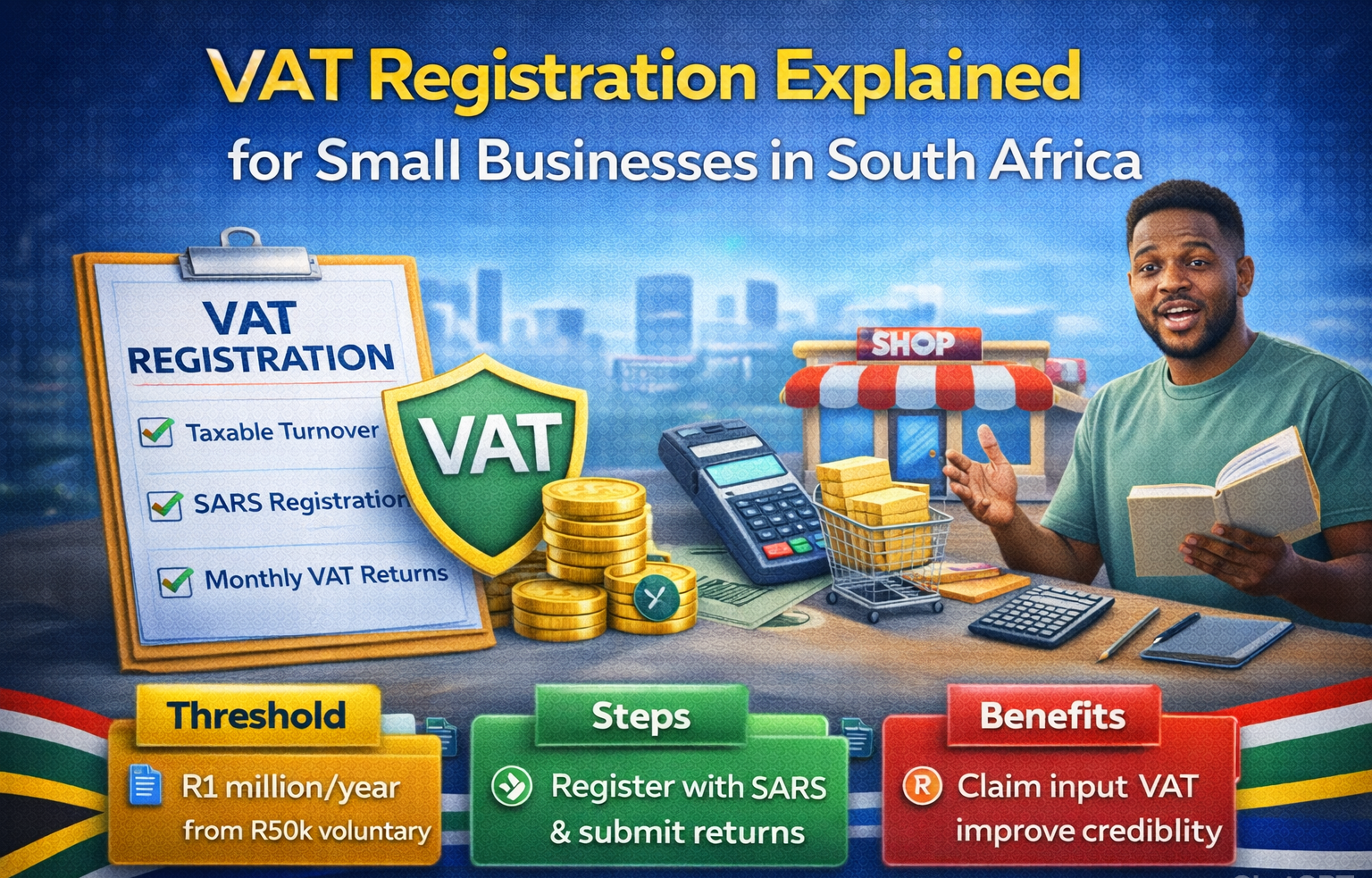
If you run a small business, you’ve probably wondered:
-
Do I need to register for VAT?
-
When does VAT become compulsory?
-
Is voluntary VAT registration worth it?
VAT sounds complicated — but once you understand the basics, it’s straightforward.
Let’s break it down clearly.
What Is VAT?
VAT (Value-Added Tax) is a 15% tax added to most goods and services in South Africa.
It is administered by the
South African Revenue Service (SARS)
If your business is VAT-registered:
-
You charge 15% VAT on your sales
-
You collect VAT on behalf of SARS
-
You can claim VAT back on business expenses
-
You submit VAT returns (usually every two months)
When Is VAT Registration Mandatory?
VAT registration becomes compulsory when:
✔ Your business turnover exceeds R1 million within any consecutive 12-month period
Important:
-
Turnover means total sales — not profit.
-
It does not matter whether your business is a sole proprietor or a Pty Ltd.
-
Once you hit R1 million, you must register within 21 days.
Failure to register on time can result in:
-
Penalties
-
Backdated VAT payments
-
Interest charges
When Can You Register Voluntarily?
You may register voluntarily if:
✔ Your turnover exceeds R50,000 within a 12-month period
This is optional — but sometimes strategic.
When Is VAT Registration a Good Idea?
Voluntary VAT registration may benefit you if:
-
Your clients are other VAT-registered businesses
-
You have high startup or operating expenses
-
You want your business to look more established
-
You plan to apply for government tenders
-
You’re growing rapidly
Being VAT-registered can increase credibility in B2B industries.
When Might VAT Registration Not Be Ideal?
VAT registration may not be suitable if:
-
You sell mainly to individuals (consumers)
-
Your prices are very price-sensitive
-
Your turnover is still low
-
You prefer simpler bookkeeping
Remember: Once registered, you must submit VAT returns regularly — even if you made no sales.
How Does VAT Actually Work? (Simple Example)
Let’s say:
-
You sell a service for R1,000
-
You add 15% VAT (R150)
-
Your client pays R1,150
You collected R150 for SARS.
Now imagine you bought business supplies and paid R300 VAT.
You can subtract that R300 from the VAT you collected.
You only pay the difference to SARS.
What Do You Need to Register for VAT?
You will need:
-
Company registration documents (if registered with
Companies and Intellectual Property Commission (CIPC)) -
Proof of business address
-
Bank confirmation letter
-
Identity documents of directors
-
Financial records showing turnover
Registration is done via SARS eFiling or at a SARS branch.
How Often Must VAT Returns Be Submitted?
Most small businesses submit VAT returns:
✔ Every 2 months
Some may qualify for:
✔ Monthly submissions
✔ 6-month submissions (for smaller qualifying businesses)
Common VAT Mistakes Small Businesses Make
❌ Registering too late
❌ Forgetting to submit “nil returns”
❌ Mixing personal and business expenses
❌ Not keeping proper invoices
❌ Not setting aside collected VAT
Remember: The VAT you collect is not your money — it belongs to SARS.
Final Thoughts
VAT registration is not just about compliance — it’s about positioning your business correctly.
✔ If you’re growing quickly, VAT may be necessary.
✔ If you serve corporate clients, VAT can add credibility.
✔ If you’re still small and serving consumers, it may not be urgent.
Understanding VAT early helps you avoid penalties and manage cash flow properly.
Frequently Asked Questions
Yes, once turnover exceeds R1 million in a 12-month period.
Yes, voluntarily from R50,000 turnover.
Not necessarily. You only pay VAT collected minus VAT paid on expenses.
Yes. Business structure does not prevent VAT registration.