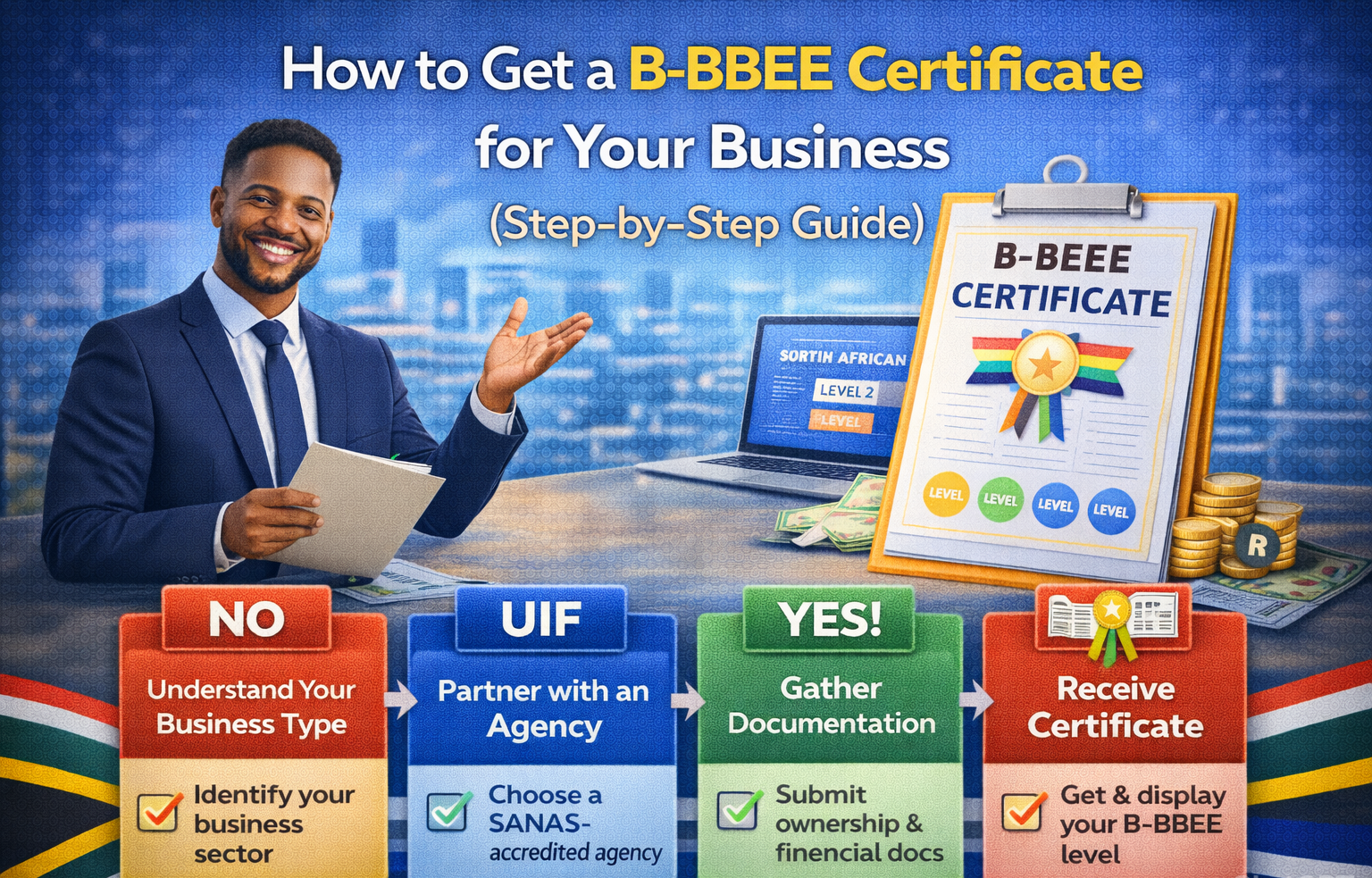
If you want to apply for:
Government tenders
Corporate supplier databases
Business funding
Enterprise development programs
You’ll likely be asked for a B-BBEE certificate.
But how do you get one?
And does every business need the same type?
Let’s break it down clearly.
What Is a B-BBEE Certificate?
A B-BBEE certificate proves your business’s Broad-Based Black Economic Empowerment (B-BBEE) status.
B-BBEE is governed under the
Broad-Based Black Economic Empowerment Act
It measures how your business contributes to economic transformation through:
Ownership
Management control
Skills development
Enterprise & supplier development
Socio-economic development
Your business receives a B-BBEE level from Level 1 (highest) to Level 8.
Do All Businesses Need a B-BBEE Certificate?
Not all businesses are measured the same way.
It depends on your annual turnover.
EME (Exempted Micro Enterprise)
If your turnover is R10 million or less per year, you qualify as an EME.
EMEs:
Automatically qualify for Level 4 (or higher if 100% black-owned)
Do NOT need full verification
Can obtain a B-BBEE affidavit instead of a full certificate
This is the simplest and cheapest option.
QSE (Qualifying Small Enterprise)
If your turnover is between:
R10 million – R50 million per year
You must be measured against the QSE scorecard and may need formal verification.
Generic Enterprise
If turnover exceeds R50 million, full verification and scoring are required.
How to Get a B-BBEE Certificate (Step-by-Step)
Step 1: Determine Your Turnover Category
Confirm whether you are:
EME
QSE
Generic
This determines your process.
Step 2: Choose the Right Type of Certificate
✔ For EMEs (Under R10 million)
You can obtain:
A B-BBEE affidavit (free or low cost)
ORA certificate from a verification agency
Most small businesses use an affidavit.
Step 3: Complete an Affidavit (For EMEs)
An EME affidavit must:
Be signed before a Commissioner of Oaths
State your annual turnover
Declare black ownership percentage
The affidavit is valid for 12 months.
Step 4: Use an Accredited Verification Agency (For QSE & Generic)
Verification must be done by agencies accredited by the
South African National Accreditation System (SANAS)
They will:
Assess your ownership
Evaluate scorecard elements
Issue a B-BBEE certificate
What Documents Do You Need?
For EMEs:
Company registration documents (if registered with
**Companies and Intellectual Property Commission)ID copies of owners
Financial statements or turnover confirmation
For QSE/Generic:
Financial statements
Payroll records
Skills development records
Ownership structure documents
Supplier development contributions
How Long Is a B-BBEE Certificate Valid?
✔ 12 months from date of issue
✔ Must be renewed annually
Expired certificates are not accepted for tenders or supplier registrations.
How Much Does It Cost?
EME Affidavit: Often free (just Commissioner of Oaths stamp)
EME Certificate via agency: Low cost
QSE Verification: Moderate cost
Generic Verification: Higher cost
Costs depend on complexity and verification provider.
Common Mistakes to Avoid
❌ Using expired certificates
❌ Incorrectly declaring turnover
❌ Not renewing annually
❌ Using non-accredited verification agencies
❌ Confusing an affidavit with a full certificate
Always verify legitimacy before submission.
Why a B-BBEE Certificate Matters
A valid B-BBEE certificate helps you:
✔ Win government tenders
✔ Qualify for enterprise development support
✔ Attract corporate clients
✔ Improve funding opportunities
✔ Increase competitiveness
Many large companies require supplier B-BBEE status for procurement compliance.
Final Thoughts
Getting your B-BBEE certificate is not just about compliance — it’s about opportunity.
If your business wants to grow, supply larger companies, or access government contracts, this certificate becomes extremely important.
The good news?
For most small businesses (EMEs), the process is simple and affordable.
Frequently Asked Questions
Not legally mandatory for all businesses — but often required for tenders and supplier contracts.
Yes. All businesses can obtain a B-BBEE level based on scorecard performance.
Yes, if they meet turnover thresholds.
Only from accredited agencies or via valid affidavit process.