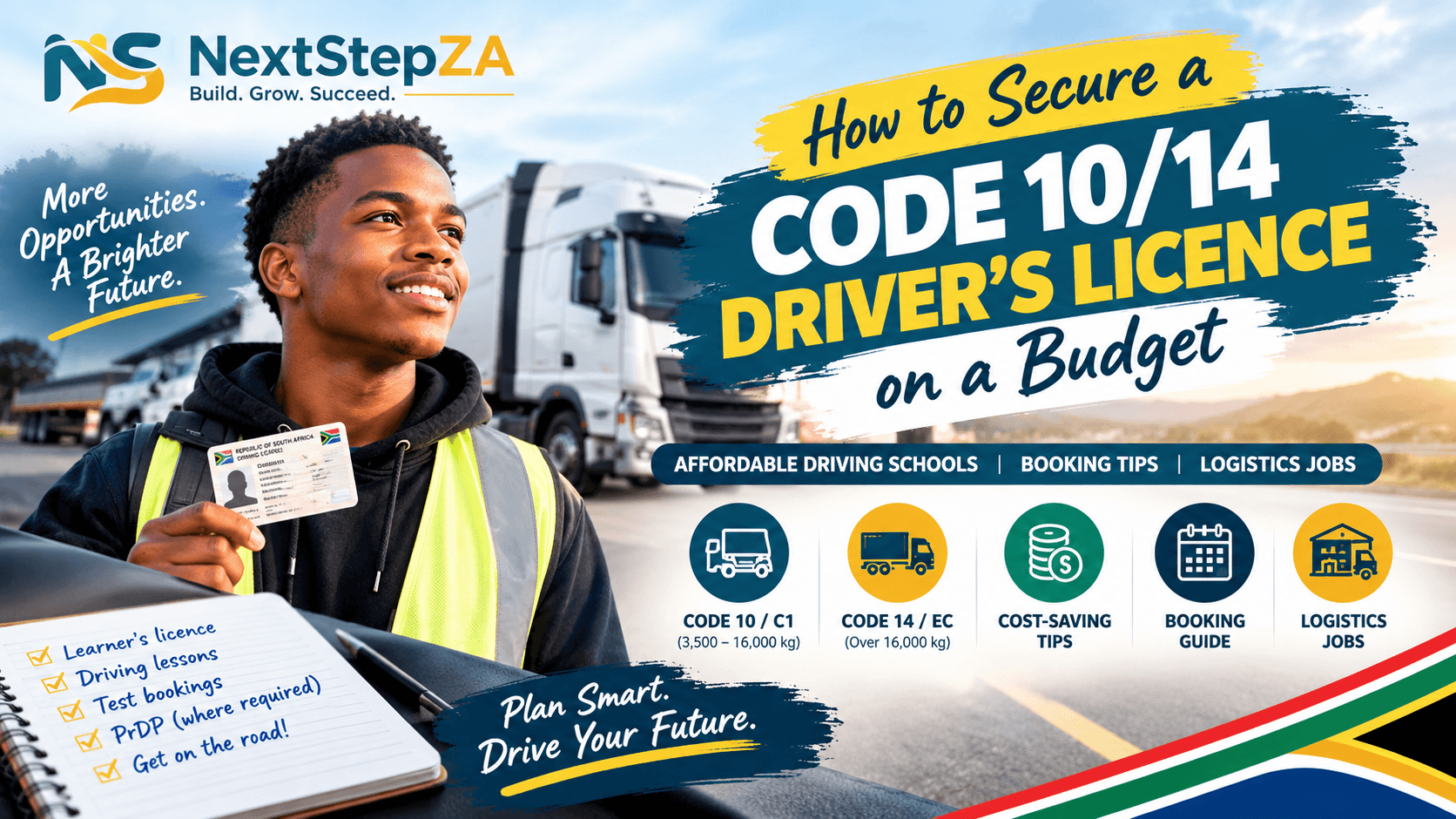
A driver’s licence can be much more than a way to get around.
For many South Africans, getting a Code 10 or Code 14 licence can open the door to jobs in transport, logistics, warehousing, distribution, construction, mining, retail delivery and other industries.
But there is one major problem:
Getting a heavy vehicle licence can be expensive.
You may need money for:
Learner’s licence fees
Driving lessons
Test bookings
Vehicle or truck hire
Licence issuing fees
Medical examinations where applicable
Professional Driving Permit (PrDP), depending on the job
Transport to and from the testing centre
The good news is that you don’t necessarily have to pay for everything at once.
This guide explains how to plan your licence journey on a budget, how to compare driving-school prices, how provincial booking systems work, and how a heavy vehicle licence can connect you to logistics and transport careers.
Important: “Code 10” and “Code 14” are common older terms. In the current licence system, Code 10 generally corresponds to Code C1, while Code 14 generally corresponds to Code EC. Always confirm the exact licence category required for the vehicle and job you are targeting.
Code 10 vs Code 14: What Is the Difference?
Before spending money on lessons, make sure you are applying for the correct licence.
Code 10 / Code C1
The current Code C1 category covers motor vehicles, buses, minibuses and goods vehicles with a gross vehicle mass between 3,500 kg and 16,000 kg.
The minimum age to apply is 18.
This category is commonly associated with jobs involving medium-sized trucks and commercial vehicles.
Examples can include:
Delivery trucks
Medium goods vehicles
Distribution vehicles
Certain construction vehicles
Some municipal vehicles
Other commercial vehicles within the C1 weight category
Code 14 / Code EC
The current Code EC category covers articulated heavy motor vehicles with a gross combination mass exceeding 16,000 kg, as well as certain heavy vehicle and trailer combinations.
The minimum age to apply is 18.
This is the licence category commonly associated with what people still call a Code 14.
It is relevant to careers involving:
Articulated trucks
Freight transport
Long-haul trucking
Heavy logistics
Distribution
Certain mining and industrial transport operations
Why a Code 10/14 Licence Can Matter for Employment
A driver’s licence does not guarantee employment.
However, it can become an additional qualification when combined with:
A clean driving record
Practical experience
Professional Driving Permit where required
Good communication
Basic vehicle knowledge
Safety awareness
Relevant industry experience
A good CV
For some transport jobs, employers may specifically ask for a particular licence code and a PrDP.
That means you should not stop your planning at:
“I want my Code 10.”
Instead ask:
“What licence and permits does the job I want actually require?”
Step 1: Decide What Job You Want Before Paying for Lessons
This is one of the best ways to save money.
Don’t automatically pay for a Code 14 because someone told you it is better.
Research the jobs you actually want.
For example:
If you want delivery work
You may find opportunities requiring:
Code B
Code C1
PrDP
Previous driving experience
depending on the vehicle.
If you want medium truck work
Look for:
C1 / Code 10
PrDP where required
Driving experience
Basic vehicle knowledge
If you want articulated truck work
Look for:
EC / Code 14
PrDP where required
Relevant experience
Additional employer requirements
The exact requirements differ between employers.
Step 2: Get Your Learner’s Licence First
Before applying for a driving licence, you need a learner’s licence.
The South African government states that a learner’s licence is required before applying for a driving licence.
A learner’s licence is valid for 24 months and cannot be extended.
For heavy vehicle categories, the appropriate learner category must be selected.
The Western Cape Government, for example, identifies Code EC as the current category corresponding to the old Code 14 terminology.
Step 3: Don’t Pay a Driving School Before Comparing Prices
Driving-school prices can vary substantially.
Instead of asking:
“How much is Code 10?”
ask:
“How much will it cost me from learner’s licence through to the driving test?”
Those are two very different questions.
A cheap hourly lesson can become expensive if you later discover that:
Truck hire is extra
Test booking is extra
Test-day vehicle hire is extra
Pick-up is extra
Learner support is extra
Licence fees are excluded
What Current Driving School Prices Look Like
Prices change, promotions expire and different schools include different services.
The following examples were publicly advertised by driving schools in 2026 and should be treated as price examples rather than official government fees or recommendations.
Example: Code 10
Ditheto Driving Academy in Randburg advertises Code 10 lessons at R250 per hour.
Kudu Driving School advertises a 10-lesson Code 10 package for R1,200, with truck hire and other fees listed separately.
Psalms Driving School advertises a Code 10 package of R2,950 for 10 lessons in its current promotional pricing.
These prices demonstrate why comparing the total package is important.
Example Code 14 Prices
Code 14 training is normally more expensive because training involves heavy vehicles and, depending on the package, articulated truck and trailer hire.
For example:
Ditheto advertises Code 14 lessons at R350 per hour.
Kudu advertises 10 Code 14 lessons for R2,600, with test-day truck hire separately listed at R1,500.
Thabo La Kgosi Driving School advertises a Code 14 package at R5,499, including five lessons, transport, truck/trailer hire and a booking slot.
Kasong Driving School in Pretoria/Centurion advertises various Code 14 packages, including 10 lessons plus a driving test at R11,500.
These are advertised prices, not endorsements. Always confirm the current price and exactly what is included before paying.
The Cheapest Option Isn’t Always the Lowest Total Cost
Imagine School A charges:
R200 per lesson
while School B charges:
R300 per lesson
At first glance, School A looks cheaper.
But suppose:
School A
10 lessons = R2,000
Truck hire = R1,500
Test booking = R300
Transport = R500
Total = R4,300
School B
10 lessons = R3,000
Truck hire = included
Test booking = included
Transport = included
Total = R3,000
The second school costs more per lesson but less overall.
That’s why you should always compare total cost to test day.
Use This Driving School Comparison Checklist
Before paying a deposit, ask the school:
1. How much are the lessons?
Ask for:
Single lesson price
5-lesson price
10-lesson price
2. Is the test booking included?
Some packages include it.
Others charge separately.
3. Is the test vehicle included?
This is particularly important for Code 10 and Code 14.
4. Is transport included?
Ask whether they collect you from your area.
5. Are learner’s licence costs included?
Don’t assume they are.
6. Are government fees included?
Ask for a complete written breakdown.
7. What happens if I fail?
Ask:
Cost of another test
Cost of another vehicle hire
Cost of additional lessons
8. Can I pay in stages?
This can make the licence more manageable if you have limited income.
How to Get Your Licence on a Tight Budget
You don’t necessarily need thousands of rands available at once.
Instead, break the journey into stages.
Stage 1: Learner’s Licence
Save specifically for:
Application
Test fee
Issuing fee
Transport
Study materials
Use the official requirements rather than paying a third party unnecessarily.
Stage 2: Theory Preparation
This is where you can potentially save money.
You don’t have to spend a large amount on private theory lessons if you can study effectively yourself.
Use:
K53 study material
Road-sign practice
Learner test practice
Official road rules
Free educational resources
Your existing NextStepZA K53 Driving Guide
The government confirms that learner applicants should study road signs, motor vehicle controls and road rules before taking the test.
Stage 3: Practical Lessons
Instead of automatically buying 20 or 30 lessons, start with a smaller package where possible.
For example:
5 lessons
↓
Assess your progress
↓
Take another 5 if needed
↓
Book the test when your instructor believes you are ready
This approach can help prevent you from paying for unnecessary lessons.
However, don’t reduce lessons so much that you are unprepared for a heavy-vehicle test.
The objective is:
Spend efficiently — not simply spend as little as possible.
Stage 4: Practise the Test Route
Ask your instructor:
“Can we practise around the actual testing area?”
This can help you become familiar with:
Intersections
Traffic patterns
Road markings
Parking areas
Yard manoeuvres
Hill starts
Observation routines
Vehicle controls
But remember that you must learn to drive safely, not merely memorise one route.
Step 5: Book Your Test Through the Correct Channel
The national government guidance says applicants book their driving test through a Driving Licence Testing Centre (DLTC).
Gauteng residents are directed to use the NaTIS online portal for driving-licence applications and bookings.
This is important because you should be careful about people claiming:
“I can sell you a guaranteed driving test.”
A driving school can assist you with the process, but you should still verify your booking through official channels.
Gauteng Booking Tips
Gauteng has expanded its Smart Licensing Centre network.
As of August 2026, Gauteng government information listed Smart Licensing Centres at locations including:
Umphakathi Mall
Denlyn Mall
Atteridgeville Mall
Protea Glen Mall
Maponya Mall
Gautrain Centurion
Gautrain Midrand
Sandton
The RTMC DLTC at Waterfall Park – Halfway House was also listed with extended operating hours.
Gauteng says appointments are made through the NaTIS online portal and that booking is essential at these Smart Licensing Centres.
Budget tip
If your closest centre has no convenient appointment, check other authorised centres where you are eligible to book rather than immediately paying someone for an unofficial “slot”.
What About Other Provinces?
Booking procedures can differ by province and municipality.
The national government advises applicants to use their nearest DLTC for driving-licence applications, while Gauteng has specific online-booking arrangements.
Western Cape
The Western Cape’s official information says learner’s licence testing is conducted through the Computerised Learners Licence Testing system and applicants book through a DLTC.
The Western Cape also publishes its own provincial information on licence services and fees.
Mpumalanga
Applicants should check the relevant Mpumalanga DLTC/municipality for current booking arrangements, fees and appointment availability.
KwaZulu-Natal
Check the relevant DLTC or provincial transport authority for the current booking process and applicable fees.
Eastern Cape, Free State, Limpopo, North West and Northern Cape
The same principle applies:
Check the current official provincial/municipal licensing information before paying a third party.
Because booking systems, availability and fees can change, don’t rely on an old Facebook post or WhatsApp message for current information.
Don’t Pay Someone Just to “Find You a Date”
This is one of the biggest budget traps.
If you can legally make the booking yourself, you may save money by doing it yourself.
Before paying a booking agent, ask:
What exactly am I paying for?
Is the government fee included?
Will I receive an official receipt?
Can I verify the booking?
Is the person operating as a legitimate driving school or service provider?
Never hand over your banking details, PIN or OTP to someone claiming they need it to secure a licence appointment.
What Documents Will You Need?
For a driving licence application, government guidance lists documents including:
Learner’s licence
Identity document
Four identical photographs, subject to confirmation with the DLTC
Proof of residential address
Booking fee
You complete the DL1 driving-licence application at the testing centre.
Requirements can vary depending on circumstances, so confirm with the relevant DLTC before attending.
How Long Does the Driving Licence Take?
After passing the driving test, you receive a temporary driving licence while the card is being produced.
The South African government says the driving licence should generally be ready within four to six weeks.
Don’t assume you will receive the physical card immediately after passing.
The Part Many Job Seekers Forget: PrDP
Getting your Code C1 or EC licence may not be the final step if your goal is professional driving.
A Professional Driving Permit (PrDP) may be required when driving certain vehicles commercially.
The South African government states that a PrDP is required for driving on public roads while transporting goods, dangerous goods or passengers for income in specified categories, including goods vehicles over 3,500 kg.
This can therefore be highly relevant to people pursuing commercial transport and logistics jobs.
What Do You Need for a PrDP?
Government guidance says you need:
A valid driving licence for the relevant vehicle type
Medical certification
Other required documentation
Compliance with the applicable criminal-record requirements
Prescribed application fee
The process is handled through a DLTC.
Gauteng residents are directed to apply online through NaTIS.
The government states that a PrDP application may take up to 12 weeks.
So if you are planning to apply for a truck-driving job, don’t wait until the last minute to investigate the PrDP requirement.
PrDP Age Requirements
The government currently lists:
Goods vehicle: 18+
Passenger vehicle: 21+
Dangerous goods: 25+
Different categories also have additional requirements.
This is particularly important if you are applying for fuel, hazardous-material or other specialised driving positions.
Code 10/14 Licence → Logistics Career Pathway
Now let’s connect the licence to employment.
A possible pathway is:
Learner’s Licence
↓
Code C1 / Code 10
↓
Practical driving experience
↓
PrDP where required
↓
Entry-level logistics / delivery / transport work
↓
More experience
↓
Heavy vehicle / specialised driving opportunities
For someone pursuing articulated trucking:
Learner’s Licence
↓
EC / Code 14
↓
PrDP where required
↓
Truck-driving experience
↓
Long-haul / freight / logistics opportunities
Your exact career path will depend on employer requirements and your experience.
What Jobs Can You Search For?
Once you have the appropriate licence, don’t search only for:
“Code 10 driver jobs.”
Use multiple search terms.
Try:
Code 10 driver
C1 driver
Delivery driver
Truck driver
Driver / messenger
Logistics driver
Distribution driver
Fleet driver
Warehouse driver
Transport driver
Code 14 driver
EC driver
Heavy vehicle driver
Articulated truck driver
Freight driver
Logistics assistant
Driver assistant
The exact licence and PrDP requirements will vary by vacancy.
Don’t Ignore Driver Assistant Jobs
This is particularly useful if you don’t yet have enough driving experience.
Some people make the mistake of thinking:
“I need a truck-driving job before I can get experience.”
Instead, look at the wider logistics ecosystem.
You could search for:
Driver assistant
General worker – logistics
Warehouse assistant
Dispatch assistant
Loading assistant
Delivery assistant
Fleet assistant
Logistics clerk
These roles can help you learn how the industry operates while you work towards your longer-term driving goal.
Other Skills That Can Make You More Employable
A licence is useful, but additional skills can strengthen your CV.
Consider learning:
Basic vehicle checks
Understand:
Tyres
Oil
Coolant
Lights
Brakes
Basic safety checks
Workplace safety
Learn about:
PPE
Load safety
Road safety
Incident reporting
Defensive driving
Communication
Drivers often interact with:
Customers
Dispatchers
Supervisors
Warehouse staff
Security
Fleet managers
Basic technology
Many logistics companies use:
GPS
Smartphones
Delivery apps
Electronic proof of delivery
Route-planning systems
Basic digital literacy can therefore be useful.
Build a Driver CV Before You Have a Driver Job
You don’t need to wait until you are employed as a truck driver to prepare your CV.
Your CV can include:
Personal details
Name
Phone number
Email
Location
Licence
Example:
Code C1 / Code 10 Driver’s Licence
or
Code EC / Code 14 Driver’s Licence
Only list a licence you actually hold.
PrDP
If you have one, state the relevant category.
Experience
Include genuine experience such as:
Delivery work
Driving work
Warehouse work
General logistics
Vehicle-related work
Customer service
Skills
Examples:
Route planning
Time management
Vehicle safety checks
Customer service
Communication
Basic vehicle maintenance
Never invent experience.
How to Save for Your Licence
If money is tight, create a dedicated Driver Licence Fund.
For example, instead of trying to save R10,000 at once:
Target 1
Learner’s licence
↓
Target 2
First 5 lessons
↓
Target 3
Next 5 lessons
↓
Target 4
Test booking and vehicle
↓
Target 5
Licence issuing costs
↓
Target 6
PrDP, if required
This makes the goal easier to manage.
Example Monthly Saving Plan
Suppose your target is R6,000.
Instead of thinking:
“I need R6,000.”
Break it down:
| Monthly saving | Time to R6,000 |
|---|---|
| R500 | 12 months |
| R750 | 8 months |
| R1,000 | 6 months |
| R1,500 | 4 months |
| R2,000 | 3 months |
This is simply a mathematical planning example.
Your actual licence cost will depend on your province, licence category, driving school, lessons and government fees.
How to Reduce the Total Cost
1. Compare at least three driving schools
Don’t choose the first school you find.
2. Ask for the full price
Not just the lesson price.
3. Consider pay-as-you-go lessons
This can be useful if you don’t have enough money for a large package.
4. Study theory yourself
Use reliable K53 material and practise extensively.
5. Avoid unnecessary repeat tests
Being properly prepared can prevent additional test and vehicle-hire costs.
6. Ask about discounts
Some schools offer:
Student specials
Group discounts
Cash discounts
Monthly payment options
Package specials
7. Ask about test-day vehicle hire
This can be a major hidden cost.
How to Choose a Legitimate Driving School
Before paying:
Ask for proof of registration
South African government guidance states that driving instructors must be registered with the provincial Department of Transport and hold the appropriate instructor grade.
Ask who will teach you
You want to know:
Instructor’s name
Instructor qualification/registration
Licence category they teach
Vehicle used for training
Check the vehicle
For heavy vehicle training, inspect the vehicle if possible.
Get the price in writing
WhatsApp confirmation is better than a verbal promise, but a formal quotation/invoice is preferable.
Warning Signs of a Driving Licence Scam
Be careful if someone says:
🚩 “Pay me and I will guarantee that you pass.”
🚩 “You don’t need to do the test.”
🚩 “I can make a licence without you driving.”
🚩 “Send me your OTP.”
🚩 “Pay cash and I will give you the licence.”
🚩 “No learner’s licence required.”
🚩 “I have someone inside the traffic department.”
A legitimate driving process requires you to meet the legal requirements and complete the applicable tests.
Your Budget Driving Licence Plan
Here is a simple plan you can follow.
Month 1
Research
Choose C1 or EC
Research jobs
Compare schools
Check your local DLTC
Start saving
Month 2
Learner’s licence
Study
Book
Pass
Receive learner’s licence
Month 3
Practical training
Take first lessons
Identify weaknesses
Practise consistently
Month 4
Test preparation
Practise K53
Practise yard work
Practise road driving
Confirm test booking
Month 5
Driving test
Take your test
If successful, pay the issuing fee
Receive temporary licence
After passing
Employment preparation
Update CV
Investigate PrDP requirements
Apply for driver and logistics jobs
Build experience
The actual timeline will vary depending on appointment availability, finances and your readiness.
A Simple Driver Job Search Strategy
Don’t wait until your licence is in your hand.
Start researching vacancies while training.
Create a spreadsheet with:
| Company | Job | Licence | PrDP | Experience | Closing Date | Applied |
|---|---|---|---|---|---|---|
| Company A | Driver | C1 | Yes | 1 year | Date | ✓ |
| Company B | Driver Assistant | None/C1 | No | None | Date | ✓ |
| Company C | Truck Driver | EC | Yes | 2 years | Date | ✓ |
This helps you identify what employers are actually asking for.
It also tells you which qualification or experience you should work towards.
The Logistics Industry Is Bigger Than Driving
If your long-term goal is logistics, you don’t have to become a driver immediately.
Other career areas include:
Warehouse operations
Dispatch
Fleet administration
Stock control
Logistics administration
Procurement
Transport coordination
Route planning
Supply chain
Distribution
Operations
This means your driving licence can become one part of a broader logistics career plan.
Code 10/14 Budget Checklist
Before you start, save this checklist:
☐ Decide whether you need C1/Code 10 or EC/Code 14
☐ Research the jobs you want
☐ Check the employer’s licence requirements
☐ Find your nearest DLTC
☐ Check current government fees
☐ Get your learner’s licence
☐ Compare at least three driving schools
☐ Ask for total package prices
☐ Check whether truck hire is included
☐ Check whether test booking is included
☐ Take lessons
☐ Practise K53
☐ Book your driving test through the proper channel
☐ Pass your test
☐ Apply for the physical licence card
☐ Check whether you need a PrDP
☐ Prepare your driver CV
☐ Start applying for logistics opportunities
Final Word from NextStepZA
A driver’s licence can be an important investment in your career — but you don’t have to approach it blindly.
Before spending money, understand exactly what licence you need.
Code 10 / C1 and Code 14 / EC are not the same category.
Compare driving schools.
Ask what is included.
Study your learner’s licence properly.
Practise before paying for the test.
Avoid people promising shortcuts.
And most importantly, connect your licence to a bigger plan.
Your goal shouldn’t simply be:
“I want a driver’s licence.”
It should be:
“I want a driver’s licence that helps me move into a sustainable career.”
From delivery and distribution to freight, warehousing and logistics, your licence can become one piece of a much bigger career journey.
NextStepZA — Where Ambition Meets Opportunity.
- K53 Driving Guide
- Government Jobs in South Africa
- TVET Colleges in South Africa 2027
- NATED Courses N1–N6
- Government Programs for Youth in South Africa
- Career Store
- Jobs Closing Soon
Frequently Asked Questions
The term Code 10 is commonly used for what is now generally referred to as Code C1. C1 covers vehicles between 3,500 kg and 16,000 kg.
The old Code 14 terminology is commonly associated with the current Code EC category for heavy articulated vehicles. The Western Cape Government explicitly describes EC as the old Code 14 category.
The current government information states that applicants must be at least 18 years old for C1 and EC.
Yes. The South African government states that you need a learner’s licence before applying for a driving licence.
A learner’s licence is valid for 24 months and cannot be extended.
There is no single national total because costs vary according to the province, DLTC fees, driving-school lessons, vehicle hire and other expenses. Current advertised driving-school examples show substantial variation, so compare complete packages rather than only hourly rates
Code 14/EC training is generally more expensive because of the heavy vehicle and articulated combination involved. Current advertised packages vary substantially, so request a full written quotation.
Depending on the vehicle and commercial activity, a PrDP may be required. Government guidance states that PrDPs apply to specified commercial passenger, goods and dangerous-goods driving activities.
The government states that a PrDP may take up to 12 weeks.
Some employers require previous experience while others may advertise entry-level or trainee opportunities. Always check the individual vacancy.